
2026 Chevrolet Colorado vs 2026 Ford Ranger: Why Colorado Is the Better Midsize Truck in Saskatchewan
A midsize truck in Saskatchewan has to cover more than one job. It tows a trailer on the weekend, hauls tools and lumber through the week, and still needs to feel comfortable on a highway commute. The 2026 Chevrolet Colorado and 2026 Ford Ranger both chase that mixed-use buyer, but the hardware behind each truck […]
A midsize truck in Saskatchewan has to cover more than one job. It tows a trailer on the weekend, hauls tools and lumber through the week, and still needs to feel comfortable on a highway commute. The 2026 Chevrolet Colorado and 2026 Ford Ranger both chase that mixed-use buyer, but the hardware behind each truck tells a different story.
This comparison sets aside the marketing language and looks at what actually changes day to day: towing setup, bed practicality, off-road hardware, and cabin tech. Every figure below comes from each truck’s own published specifications.
Colorado vs Ranger: Side-by-Side Specs
| Spec | Chevrolet Colorado | Ford Ranger |
| Max payload | 2,046 lbs (928 kg) (WT/LT) | 1,763 lbs (800 kg) (XL/XLT/Lariat 2.3L) |
| Max towing, properly equipped | 7,700 lbs (3,493 kg) (Trailering Package) | 7,500 lbs (3,402 kg) (XLT, Trailer Tow Package) |
| Cargo box length | 1,567 mm | 1,514 mm |
| Ground clearance, top off-road trim | 273 mm (ZR2) | 272 mm (Raptor) |
| Touchscreen / driver display | 11.3 in / 11 in, standard on every trim | 10 in / 8 in (XL) to 12 in / 12 in (Lariat) |
| Fuel tank capacity | 81 L | 68.1 L (XL/XLT/Lariat) to 75.7 L (Raptor) |
| Engine output | 310 hp / 430 lb-ft (2.7L TurboMax I4, every trim) | 270-405 hp / 310-430 lb-ft, varies by trim and engine |
| Cargo box volume | 1,186 L | 1,232.6 L (Raptor) |
Towing and Trailering: Backing Up, Hitching, and Staying Stable
Every Colorado trim runs the same 2.7L TurboMax engine and standard 4WD, so the towing conversation starts from one baseline: 3,500 lbs (1,588 kg) with a hitch and wiring harness, on a 9,100-lb (4,128 kg) GCWR. Add the Trailering Package and both numbers jump, to a 7,700-lb (3,493 kg) max tow rating and a 13,250-lb (6,010 kg) GCWR.
The Ranger Raptor actually starts ahead on paper: its standard package tows 5,510 lbs (2,499 kg), well past the Colorado’s base 3,500 lbs (1,588 kg). But once the Trailering Package is factored in, the Colorado’s 7,700-lb (3,493 kg) ceiling tops the Ranger’s own best documented figure, the 7,500 lbs (3,402 kg) rating on the XLT with its Trailer Tow Package.
The ZR2 is the exception in the Colorado lineup. It carries the Trailering Package standard but caps out at 6,000 lbs (2,722 kg) and an 11,600-lb (5,262 kg) GCWR, since its off-road-tuned suspension trades some towing headroom for trail travel.
Hitching and backing up matter as much as the max number. Hitch View and Hitch Guidance are standard on every Colorado trim, alongside standard trailer sway control through StabiliTrak and standard hill start assist. The Ranger’s comparable trailer aids, Blind Spot Information with Trailer Coverage and the 360-degree camera, only show up from the XLT and Lariat trims, so the base XL misses them.
The Trailering Package changes the ownership case for a regular tower: it’s what unlocks the 7,700-lb (3,493 kg) ceiling, and it comes standard on the Trail Boss and Z71 rather than something a shopper has to track down as an add-on.
Bed and Payload: Everyday Load-Carrying
Payload tells a clear story here. The Colorado’s WT and LT rate 2,046 lbs (928 kg), the highest number in this comparison. Even the off-road-focused Trail Boss (1,726 lbs (783 kg)/783 kg) and Z71 (1,733 lbs (786 kg)/786 kg) beat every grounded Ranger payload figure, including the 1,763 lbs (800 kg) on XL/XLT/Lariat with the four-cylinder and the 1,411 lbs (640 kg) on the Raptor.
The boxes themselves split the difference. Colorado’s is longer at 1,567 mm versus the Ranger’s 1,514 mm, but the Ranger’s box is wider and its 1,232.6 L volume edges past Colorado’s 1,186 L on paper. For loading full sheets of material or a ladder flat, the extra floor length counts for more than a few litres of volume, and the Colorado’s higher payload ratings mean more of that space can actually be loaded with weight.
Colorado also offers bedside utility walls, tie-down hardware, and a front bed utility wall across the lineup, useful for keeping tools and weekend gear organized rather than sliding around loose.
Off-Road Trims: A Stepped Path vs a Single Peak
The Ranger’s off-road case rests almost entirely on the Raptor: a 3.0L twin-turbo V6, FOX Live Valve shocks, a Watts-link rear suspension, standard front and rear locking differentials, and 272 mm of ground clearance on 33-inch tires. That is a genuinely serious build.
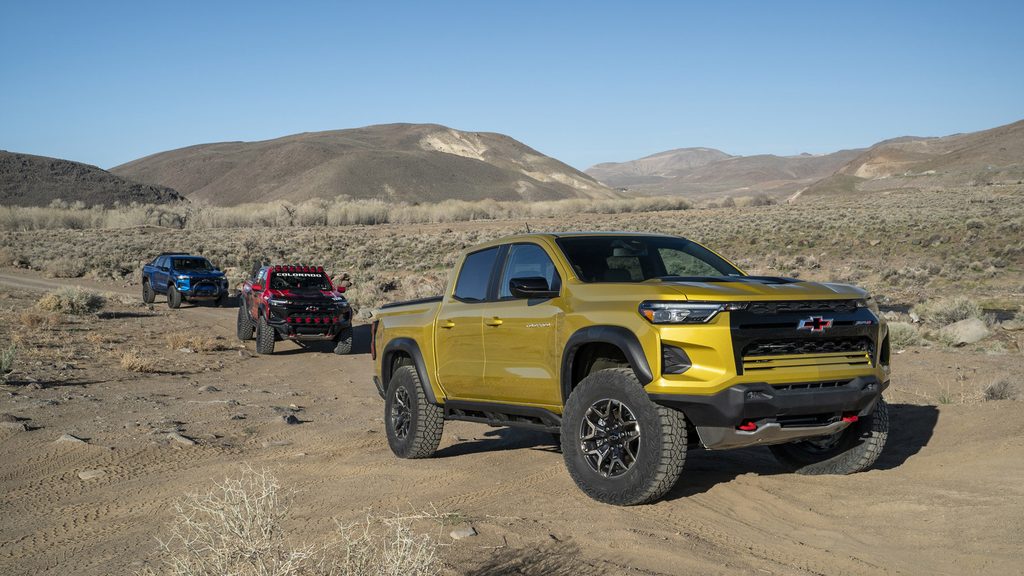
Colorado spreads the same idea across two trims instead of concentrating it in one. Trail Boss brings a 2-inch factory lift, 242 mm of clearance, a standard 2-speed Autotrac transfer case, and a standard locking rear differential, a milder step for backroad driving. ZR2 goes further, with 273 mm of clearance, Multimatic Jounce Control dampers, and driver-selectable full-locking front and rear differentials to match the Raptor’s own top-end hardware.
That structure separates buyers who want genuine off-road capability from buyers who just want the look. A Trail Boss owner gets real lift and locking hardware for light trail use without stepping straight to the top of the lineup, something the Ranger’s single-trim approach doesn’t offer in this grounding.
Cabin Technology and Comfort
Colorado’s 11.3-inch display with Google built-in and its 11-inch driver information cluster are standard on every trim, from WT to ZR2. The base six-speaker audio system is also standard across the board, with Bose Premium Sound available on Z71 and ZR2.
The Ranger’s tech scales more with trim. The XL starts with a 10-inch touchscreen and an 8-inch cluster, while the Lariat brings a 12-inch touchscreen, a 12-inch cluster, and a 10-speaker system. That Lariat setup is genuinely larger than what Colorado offers, but reaching it on the Ranger means buying into that trim. Colorado’s Google-integrated 11.3-inch display and full-size cluster ship on the base WT with no wait for a higher trim.
Powertrain and Fuel Planning
Colorado keeps it simple: one 2.7L TurboMax turbocharged four-cylinder across the entire lineup, 310 hp and 430 lb-ft, an 8-speed automatic, and standard 4WD on every trim. Fuel consumption runs 13.6 L/100 km city and 10.7 L/100 km highway on WT through Z71, and 14.1/13.8 L/100 km on the off-road-tuned ZR2.
The Ranger’s engine choice changes by trim: a 2.3L turbo four at 270 hp and 310 lb-ft on XL and XLT, an optional 2.7L twin-turbo V6 at 315 hp and 400 lb-ft, and the Raptor’s 3.0L twin-turbo V6 at 405 hp and 430 lb-ft. The Raptor’s horsepower advantage is real, but Colorado’s 430 lb-ft matches that top Ranger figure and beats every other Ranger engine’s torque number, without needing the top trim to get there.
Colorado’s 81 L fuel tank also holds more than any grounded Ranger tank, ahead of the Raptor’s 75.7 L and the 68.1 L on XL, XLT, and Lariat, stretching the distance between fill-ups on longer Saskatchewan drives. A buyer who wants one predictable engine and standard 4WD on every trim, rather than shopping between engine options to unlock capability, gets that with the Colorado’s single-powertrain layout.
Why the Colorado Fits Saskatchewan Drivers
For a truck that tows on the weekend, carries a full payload midweek, and handles mixed highway and gravel driving the rest of the time, the Colorado’s standard 4WD, class-leading payload figures in this comparison, and factory trailering hardware do more of that work without requiring a jump to the top trim.
The stepped path from Trail Boss to ZR2 lets a buyer match capability to actual use, whether that’s a mild lift for backroads or a fully locked-up build for serious trails. A work-first buyer leans toward the WT or LT for maximum payload; a buyer who wants comfort with real trailering hardware fits the Z71; a buyer chasing trail capability has Trail Boss and ZR2 as two distinct destinations. The Colorado covers all of it from one lineup.
See the Colorado’s Trailering Setup in Saskatoon
The 2026 Chevrolet Colorado pairs a single, torque-rich TurboMax engine with standard 4WD, factory trailering hardware, and a stepped path from Trail Boss to ZR2, giving Saskatchewan drivers a midsize truck built around towing, hauling, and daily mixed-use driving.
Visit Saskatoon Motor Products Chevrolet in Saskatoon to see the Colorado’s trim lineup and trailering equipment in person, and book a test drive that puts its towing setup, cabin tech, and off-road stance to the test.