
AWD Standard, 1,500 lbs of Towing, OnStar Included: Why the 2026 Equinox Holds Its Own Against the CR-V
The compact SUV segment asks a lot of a vehicle. It needs to handle Saskatoon winters, carry enough for a family weekend, and keep fuel costs manageable on Saskatchewan’s long highway stretches. The 2026 Chevrolet Equinox and 2026 Honda CR-V both answer that brief — but they do it differently. The Equinox leads with a […]
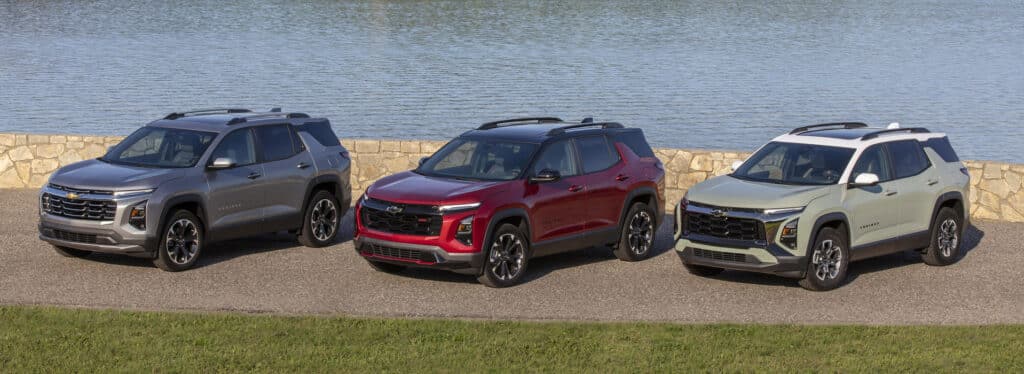
The compact SUV segment asks a lot of a vehicle. It needs to handle Saskatoon winters, carry enough for a family weekend, and keep fuel costs manageable on Saskatchewan’s long highway stretches. The 2026 Chevrolet Equinox and 2026 Honda CR-V both answer that brief — but they do it differently. The Equinox leads with a broader standard safety suite, AWD across most of its lineup, and a towing rating that matches the CR-V’s gasoline configuration. The CR-V leads with a hybrid powertrain option and a larger cargo floor.
This comparison works through the specs that matter for Saskatoon buyers: fuel economy, safety, cargo, towing, and technology. The goal is a clear picture of where each SUV earns its keep and where it asks for compromise.
At a Glance: 2026 Equinox vs. 2026 CR-V
| Feature | 2026 Chevrolet Equinox | 2026 Honda CR-V (Turbo AWD) |
| Engine | 1.5L Turbo 4-cylinder | 1.5L Turbo 4-cylinder |
| Horsepower | 175 hp (GM estimate) | 190 hp |
| AWD Fuel Economy (City/Hwy) | 9.6 / 8.1 L/100 km | 9.1 / 7.6 L/100 km |
| Cargo Volume (seats up / folded) | 844 L / 1,798 L | 1,113 L / 2,166 L |
| Max Towing (with tow package) | 1,500 lbs (680 kg) | 1,500 lbs (680 kg) |
| Wheelbase | 2,730 mm | 2,700 mm |
| Standard AWD | LT, RS, Premier | Available (not standard LX) |
Powertrain and Fuel Economy
Both vehicles use a 1.5L turbocharged 4-cylinder engine in their base configurations. The 2026 Equinox produces 175 hp (GM estimate) from that 1.5L Turbo. The CR-V Sport AWD produces 190 hp and 179 lb-ft of torque.
On fuel economy, the CR-V has a measurable advantage in both gasoline AWD configurations. The Equinox AWD returns 9.6 L/100 km city and 8.1 L/100 km highway. The CR-V Sport AWD returns 9.1 city and 7.6 highway. For buyers covering long Saskatchewan highway distances regularly, that 0.5 L/100 km highway gap adds up over time.
Honda also offers four hybrid trims on the CR-V — Sport Hybrid, TrailSport Hybrid, EX-L Hybrid, and Touring Hybrid — using a 2.0L 4-cylinder two-motor hybrid system that produces 204 combined hp and 247 combined lb-ft of torque. The hybrid AWD configuration returns 6.0 city / 6.9 highway L/100 km. The Equinox does not offer a hybrid powertrain option.
For buyers where fuel economy is the primary decision factor, the CR-V hybrid is the stronger answer. For buyers who prioritise a straightforward gasoline powertrain, the turbo-vs-turbo comparison is much closer.
Towing Capacity
This is where the Equinox holds its ground. With the available trailer hitch accessory, the 2026 Equinox AWD can tow up to 1,500 lbs (680 kg).
The CR-V’s towing capacity depends heavily on which version you’re comparing. The turbo AWD matches at 1,500 lbs (680 kg) with the accessory towing package. The CR-V hybrid trims drop to 999 lbs (453 kg) — less than half the Equinox’s rating. For Saskatoon buyers who need to pull a small trailer, a personal watercraft, or a utility trailer for seasonal use, the Equinox AWD and CR-V turbo AWD deliver equivalent capability. The CR-V hybrid does not.
- Equinox AWD max towing: 1,500 lbs (680 kg)
- CR-V turbo AWD max towing: 1,500 lbs (680 kg)
- CR-V hybrid AWD max towing: 999 lbs (453 kg)
Safety and Driver-Assistance Features
The 2026 Equinox comes with a broad standard safety package across all trims. Standard features include Enhanced Automatic Emergency Braking, Intersection Automatic Emergency Braking, Rear Cross Traffic Braking, Reverse Automatic Braking, Rear Park Assist, Lane Keep Assist, Side Bicyclist Alert, Rear Seat Reminder, and Safety Alert Seat. OnStar Basics is also standard across the lineup.
The CR-V’s Honda Sensing suite is equally comprehensive and standard across all trims. It includes Adaptive Cruise Control, Collision Mitigation Braking System, Lane Departure Warning, Lane Keeping Assist, Road Departure Mitigation, Cross Traffic Monitor, Blind Spot Information, Traffic Sign Recognition, and Traffic Jam Assist.
Both vehicles deliver strong standard safety coverage. The Equinox adds OnStar connectivity as a differentiation — a live response system and remote access capability that Honda Sensing does not include.
Cargo and Interior Space
The CR-V carries a clear cargo advantage. The turbo CR-V AWD delivers 1,113 L of cargo space with seats up and 2,166 L with them folded. The hybrid trims sit slightly lower at 1,028 L / 2,030 L, owing to hybrid battery packaging under the floor.
The 2026 Equinox delivers 844 L with seats up and 1,798 L folded. That’s 269 L less than the CR-V turbo behind the second row — a meaningful difference if cargo capacity is a primary requirement.
For buyers who carry large volumes of gear regularly — camping equipment, sports bags, large purchases — the CR-V’s floor space is the more practical choice. For buyers who primarily carry passengers and moderate loads, the Equinox’s 844 L is sufficient for most Saskatoon daily use.
| Cargo Comparison | Equinox | CR-V Turbo | CR-V Hybrid |
| Seats up | 844 L | 1,113 L | 1,028 L |
| Seats folded | 1,798 L | 2,166 L | 2,030 L |
Technology and Connectivity
Both vehicles offer wireless Apple CarPlay and Android Auto standard across the lineup — no wired connection required.
The Equinox includes OnStar Basics standard and Chevrolet Safety Assist technology. The CR-V’s Touring Hybrid adds Google Built-In and a 12-speaker Bose Premium Sound System at the top of the lineup. Mid-range CR-V trims add Wi-Fi hotspot capability from Sport and above.
On the Equinox side, the available Rear Camera Mirror and rear surround camera system assist with parking and low-speed manoeuvring. Both vehicles offer a wireless Qi phone charger across their respective lineups.
Wheelbase and Ride Stability
The Equinox’s 2,730 mm wheelbase is 30 mm longer than the CR-V’s 2,700 mm. In a compact SUV, a longer wheelbase generally translates to more stable high-speed handling and a smoother ride over Saskatchewan’s highway expansion joints. Both vehicles use MacPherson strut front suspension and multi-link independent rear suspension — the architecture is comparable, but the Equinox’s longer wheelbase provides a slight geometric advantage for ride stability at highway speeds.
Which SUV Is Right for Saskatoon?
The CR-V is the stronger choice for buyers who prioritise fuel economy — especially the hybrid trims, which return 6.0/6.9 L/100 km and run on regular fuel. It also carries more cargo behind the second row, which matters for buyers who frequently haul large loads.
The Equinox makes its case on towing parity with the CR-V gasoline configuration, a longer wheelbase, OnStar connectivity, and broad standard safety coverage across every trim. For buyers who want AWD standard (not an option to add), the Equinox LT, RS, and Premier all include AWD without an upcharge. For buyers whose towing needs put them in the hybrid CR-V’s range, the Equinox AWD’s 1,500 lbs (680 kg) delivers more than twice the rated capacity.
Neither vehicle is a poor choice. But for Saskatoon drivers who regularly pull a trailer, want AWD included from the start, and value the coverage of OnStar, the Equinox resolves those priorities more directly.
See the 2026 Equinox at Saskatoon Motor Products Chevrolet
The team at Saskatoon Motor Products Chevrolet in Saskatoon can walk you through the full Equinox lineup — LS, LT, RS, and Premier — and arrange a side-by-side comparison on your schedule. Stop in or get in touch to book your test drive.